
Call (888) 688-5781

Author: faasfunding

  • BRRRR Method Explained: How to Use DSCR Loans to Scale Your Rental Portfolio

    What Is the BRRRR Strategy?

    BRRRR stands for Buy, Rehab, Rent, Refinance, Repeat. It is one of the most popular wealth-building strategies in real estate investing. The concept is simple: purchase a below-market property, renovate it to increase value, rent it out for cash flow, refinance to pull out your invested capital, and repeat the process with the recovered funds.

    When paired with DSCR loans, the BRRRR strategy becomes even more powerful because the refinance step qualifies based on the property’s rental income rather than your personal income.

    How Each BRRRR Step Works

    Step 1: Buy

    Identify undervalued properties in markets with strong rental demand. Many BRRRR investors use bridge loans or fix-and-flip financing for the initial acquisition, since the property may not qualify for long-term financing in its current condition.

    Step 2: Rehab

    Renovate the property to increase both its market value and rental appeal. Focus on improvements that maximize the after-repair value (ARV) and rental income: kitchens, bathrooms, flooring, and curb appeal typically deliver the highest returns.

    Step 3: Rent

    Once renovations are complete, place a qualified tenant and establish rental income. This step is critical for DSCR loan qualification because lenders will use the lease agreement or market rent to calculate your debt service coverage ratio.

    Use our Rental Cash Flow Calculator to project your monthly income and expenses.

    Step 4: Refinance with a DSCR Loan

    This is where DSCR loans become the ideal tool. After the property is stabilized with a tenant in place, you refinance into a long-term DSCR loan based on the new appraised value. The key benefits:

    • No personal income verification required
    • Cash-out based on the new, higher ARV
    • Close in your LLC for asset protection
    • 30-year fixed rate options for stable cash flow

    The goal is to pull out as much of your original investment as possible, ideally 100% or more, leaving you with a cash-flowing rental property and your capital freed up for the next deal.

    Check your refinance scenario with our DSCR Calculator.

    Step 5: Repeat

    Take the capital recovered from the refinance and deploy it into the next BRRRR deal. Each cycle adds another cash-flowing property to your portfolio without requiring new capital from savings.

    Why DSCR Loans Are Perfect for BRRRR

    Conventional loans create friction in the BRRRR strategy because each new mortgage increases your debt-to-income ratio, eventually capping how many properties you can finance. DSCR loans remove this obstacle entirely.

    With DSCR financing, each property stands on its own merit. As long as the rental income covers the debt payments, you can continue scaling without personal income limitations. This makes DSCR loans the preferred refinance vehicle for serious BRRRR investors.

    BRRRR Example with Numbers

    Consider this scenario:

    • Purchase price: $150,000
    • Rehab costs: $40,000
    • Total invested: $190,000
    • After-repair value (ARV): $250,000
    • Monthly rent: $2,000
    • DSCR refinance at 75% LTV: $187,500

    In this example, the investor recovers $187,500 of their $190,000 investment through the DSCR cash-out refinance, retaining a property that cash flows approximately $400-500/month after all expenses. Use our BRRRR Calculator to model your own deal.

    Common BRRRR Mistakes to Avoid

    • Overestimating ARV — Be conservative with after-repair value estimates
    • Underestimating rehab costs — Always add a 10-15% contingency buffer
    • Ignoring DSCR requirements — Make sure projected rent covers the new loan payment at a 1.0+ DSCR. Check DSCR loan requirements before committing
    • Rushing to rent — Screen tenants thoroughly; vacancy between deals is better than a bad tenant
    • Not having a seasoning plan — Most DSCR lenders require 3-6 months of ownership before a cash-out refinance

    Get Started with BRRRR Financing

    Ready to run your first or next BRRRR deal with DSCR financing? FAAS Funding provides both the short-term acquisition capital and the long-term DSCR refinance under one roof.

    Call our Capital Desk at (888) 688-5781 to discuss your BRRRR strategy and financing options.

    Before refinancing, review current <a href=”https://faasfunding.com/dscr-loan-interest-rates-2026/”>DSCR loan rates 2026</a> to understand what rate to expect on your cash-out refinance and ensure the numbers still work for your portfolio.

  • How to Qualify for a DSCR Loan in 2026: A Complete Guide for Real Estate Investors

    What Is a DSCR Loan?

    A Debt Service Coverage Ratio (DSCR) loan is an investment property financing product that qualifies borrowers based on the property’s rental income rather than the borrower’s personal income. For real estate investors looking to scale their portfolios in 2026, DSCR loans remain one of the most accessible and efficient financing options available.

    Unlike conventional mortgages that require W-2s, tax returns, and employment verification, DSCR loans focus on one key metric: whether the property generates enough income to cover its debt obligations.

    How the DSCR Ratio Works

    The DSCR ratio is calculated by dividing the property’s gross rental income by its total debt obligations (principal, interest, taxes, insurance, and HOA fees if applicable).

    DSCR = Monthly Rental Income / Monthly Debt Obligations (PITIA)

    A DSCR of 1.0 means the property’s income exactly covers its expenses. Most lenders require a minimum DSCR of 1.0 to 1.25, though some programs accept ratios as low as 0.75 for strong borrowers with larger down payments.

    Use our free DSCR Calculator to estimate your property’s ratio before applying.

    DSCR Loan Requirements in 2026

    Here are the typical requirements investors should expect when applying for a DSCR loan:

    • Minimum Credit Score: 660+ (some programs go to 620)
    • Down Payment: 20-25% minimum
    • Property Types: 1-4 unit residential, condos, townhomes, short-term rentals
    • DSCR Ratio: 1.0+ preferred, some programs accept 0.75+
    • Loan Amounts: $100K to $5M+
    • Vesting: LLC, corporation, or individual name
    • Experience: No prior experience required for most programs

    Benefits of DSCR Loans for Investors

    No personal income verification — The biggest advantage. Self-employed investors, business owners, and anyone with complex tax returns can qualify based solely on property performance.

    Faster closings — Without the need to verify income, employment, and DTI ratios, DSCR loans typically close in 21-30 days.

    Unlimited properties — Unlike conventional loans that cap at 10 financed properties, most DSCR programs have no portfolio limits.

    LLC-friendly — Close in your entity name for asset protection and liability separation.

    Short-term rental eligible — Many DSCR programs now accept Airbnb and VRBO income using projections or actual booking history.

    DSCR Loans vs. Conventional Mortgages

    The primary difference comes down to qualification method. Conventional loans look at your personal debt-to-income ratio, requiring full income documentation. DSCR loans look at whether the property pays for itself.

    For investors with multiple properties, DSCR loans avoid the stacking problem where each new conventional mortgage raises your DTI ratio, eventually making it impossible to qualify for more.

    How to Apply for a DSCR Loan

    The application process for a DSCR loan is straightforward:

    1. Submit your scenario — Provide basic property details, estimated rental income, and purchase price. Start your pre-qualification here.
    2. Get pre-qualified — A capital desk advisor reviews your scenario and matches it to the right program.
    3. Submit documentation — Lease agreements, purchase contract, entity documents, and bank statements.
    4. Close your loan — Review your term sheet, lock your rate, and close on your timeline.

    Who Should Consider a DSCR Loan?

    DSCR loans are ideal for:

    • Self-employed real estate investors
    • Investors scaling beyond 10 financed properties
    • Foreign national investors purchasing US rental property
    • Investors who want to close in an LLC
    • Short-term rental operators (Airbnb, VRBO)
    • Anyone who wants a faster, simpler qualification process

    State-Specific DSCR Programs

    DSCR loan availability and terms can vary by state. FAAS Funding offers programs nationwide, with dedicated resources for high-demand markets:

    Get Started Today

    Ready to see if your investment property qualifies for a DSCR loan? Use our free tools to analyze your deal:

    Or call our Capital Desk directly at (888) 688-5781 to discuss your investment scenario.

    Understanding <a href=”https://faasfunding.com/dscr-loan-interest-rates-2026/”>current DSCR loan rates</a> is essential before you apply — your rate directly impacts whether the property’s income covers its debt service and qualifies for approval.

  • DSCR Loan Interest Rates: What to Expect in 2026

    Understanding current DSCR loan interest rates is essential for real estate investors evaluating their financing options. Unlike conventional mortgage rates that follow the primary housing market, DSCR loan rates operate within the commercial and investment property lending space where pricing reflects different risk factors and market dynamics. This guide breaks down what investors can expect from DSCR interest rates in 2026, the factors that influence pricing, and strategies to secure the most competitive terms available.

    Current DSCR Rate Landscape in 2026

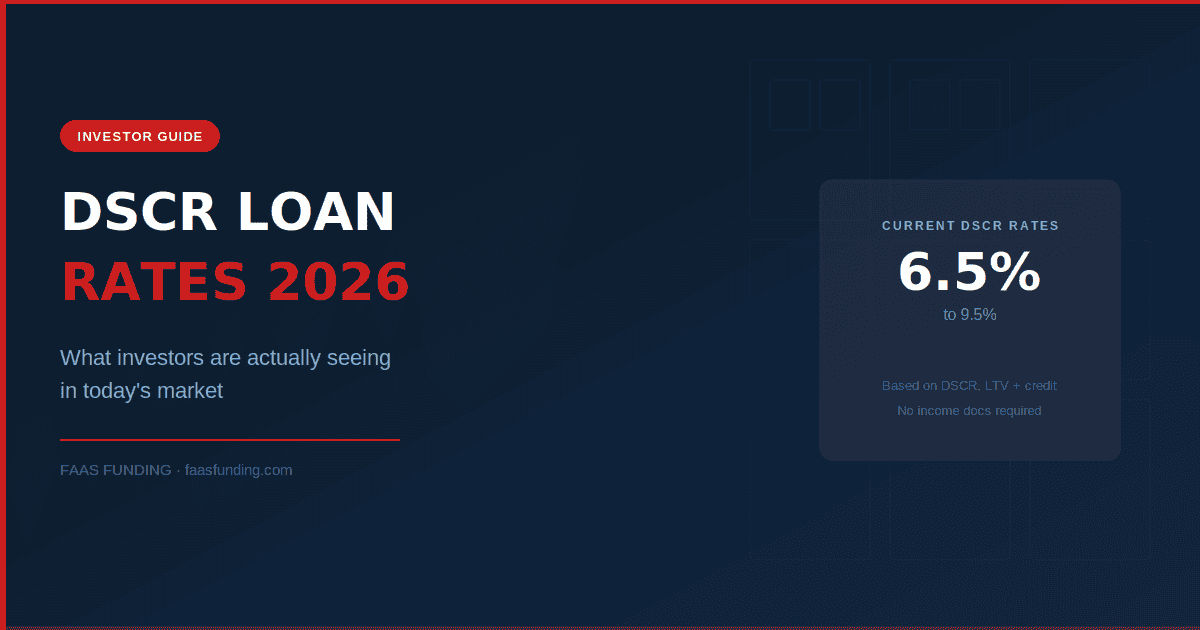
    DSCR loan interest rates in 2026 generally range from the high 6s to the low 9s depending on multiple borrower and property factors. These rates are typically 1 to 3 percentage points higher than conventional owner-occupied mortgage rates, reflecting the additional risk associated with investment property lending. The spread between DSCR and conventional rates fluctuates based on market conditions, lender competition, and the broader economic environment.
    Several macroeconomic factors are shaping the 2026 rate environment for DSCR loans. Federal Reserve monetary policy continues to influence the base cost of capital, while inflation trends and employment data affect investor sentiment and lending risk assessments. The commercial mortgage-backed securities market, which funds many DSCR loan programs, has its own supply and demand dynamics that directly impact the rates available to individual borrowers.
    Rate competition among DSCR lenders has increased significantly as more capital providers enter the investment property lending space. This competition benefits borrowers by creating downward pressure on rates and encouraging lenders to offer more flexible terms. Working with a broker or lender that sources from multiple capital providers, like FAAS Funding, gives investors access to a wider range of pricing options and increases the likelihood of finding the most competitive rate for their specific situation.

    How DSCR Loan Rates Compare to Other Loan Types

    Loan Type Rate Range (2026) Qualification Basis Best For
    DSCR Loan 6.75% – 7.75% Rental income (DSCR ratio) Investors scaling portfolios
    Conventional 6.25% – 7.25% Personal income (DTI) Owner-occupied / first property
    Hard Money 9% – 12% Asset value Fix-and-flip / bridge
    FHA Investment 5.75% – 6.75% Personal income + occupancy House hacking (1–4 units)

    What Affects Your DSCR Loan Rate?

    Multiple factors work together to determine the rate a lender offers on a DSCR loan. Understanding each one gives you leverage to negotiate better terms and structure your deal for optimal pricing:

    • Credit score — The single biggest borrower-side factor. Scores above 740 unlock the best rates; 680–740 gets moderate pricing; 620–680 pays a premium.
    • DSCR ratio — Higher ratios (1.25+) signal lower risk and earn better rates. Use our DSCR calculator to estimate your ratio and see how it impacts your rate.
    • Loan-to-value (LTV) — Larger down payments (25–30%) reduce lender exposure and typically improve your rate by 0.25–0.50%.
    • Property type — Single-family rentals, multifamily, and mixed-use properties each carry different risk profiles and rate tiers.
    • Loan term and structure — 30-year fixed rates are higher than 5/1 or 7/1 ARMs; interest-only options may offer lower initial payments.
    • Market conditions — Fed policy, inflation, and CMBS market dynamics all influence the base cost of capital for DSCR programs.

    Want to see your exact DSCR rate? Check your deal in under 60 seconds with our FAAS Investor Qualifier — get a personalized rate estimate based on your property, credit, and loan structure.

    Factors That Determine Your DSCR Interest Rate

    Your individual DSCR loan rate depends on a combination of borrower profile, property characteristics, and loan structure decisions. Credit score is the single most influential borrower factor. Investors with scores above 740 typically access the best available rates, while those in the 680 to 740 range receive moderate pricing, and borrowers between 620 and 680 pay premium rates that reflect the higher perceived credit risk.
    The property’s DSCR ratio directly influences rate pricing. Stronger ratios demonstrate more income cushion above debt service, which reduces the lender’s risk and translates into better rates. A property with a 1.30 DSCR will generally receive more favorable pricing than one at 1.05, even if the borrower profiles are identical. Some lenders offer rate tiers tied to specific DSCR thresholds, providing clear incentives for investors to target properties with robust income performance.
    Loan-to-value ratio, property type, and loan term also factor into rate calculations. Lower LTV loans where the borrower contributes a larger down payment typically receive better rates due to reduced lender exposure. Single-family rentals may price differently than multifamily or mixed-use properties. Fixed-rate terms of 30 years usually carry higher rates than shorter fixed periods or adjustable-rate structures, reflecting the lender’s interest rate risk over longer commitment periods. Understanding how each factor affects pricing helps you structure your DSCR loan application to achieve the best possible rate.

    Fixed Rate vs Adjustable Rate DSCR Loans

    DSCR loan borrowers face a fundamental choice between fixed-rate and adjustable-rate structures. Fixed-rate loans lock in your interest rate for the entire loan term, providing predictable monthly payments and protection against future rate increases. This stability makes budgeting and cash flow projections straightforward, which is particularly valuable for buy-and-hold investors planning to own properties for extended periods.
    Adjustable-rate DSCR loans typically offer lower initial rates compared to fixed-rate options. Common structures include 5/1 and 7/1 ARMs where the rate is fixed for the initial period then adjusts annually based on a benchmark index plus a margin. These products can make sense for investors planning to refinance or sell within the initial fixed period, or for those who believe rates will decline in the future. However, the uncertainty of future rate adjustments introduces risk that must be carefully evaluated.
    Interest-only payment options are available through some DSCR programs and can significantly reduce monthly debt service during the interest-only period. While this structure does not build equity through principal reduction, it maximizes cash flow and improves the effective DSCR ratio. Many investors use interest-only periods strategically during the early years of ownership, planning to refinance into a fully amortizing loan once the property’s value has appreciated and rents have increased through their investment strategy.

    Strategies to Secure the Best DSCR Rate

    Improving your credit score before applying is the highest-impact strategy for rate reduction. Even a modest score increase from 700 to 720 can translate into meaningful rate savings over the life of the loan. Review your credit reports for errors, pay down revolving balances, and avoid opening new credit accounts in the months leading up to your DSCR loan application.
    Increasing your down payment directly reduces the lender’s risk exposure and typically unlocks better rate tiers. Moving from 20 to 25 percent down, or from 25 to 30 percent, can produce noticeable rate improvements depending on the lender’s pricing matrix. Calculate the long-term interest savings against the additional capital deployed to determine whether a larger down payment makes financial sense for your specific investment scenario.
    Shopping multiple lenders and timing your rate lock strategically round out the rate optimization approach. DSCR rates can vary significantly between lenders, and the competitive landscape shifts regularly. Getting quotes from multiple sources ensures you are not leaving savings on the table. Once you identify the best rate, understanding the lender’s lock policy including duration, cost, and extension options helps you protect that rate through closing. Experienced DSCR lending professionals can guide you through the rate comparison process and help you time your lock for maximum benefit.

    DSCR Loan Rate FAQs

    What is a good DSCR loan rate in 2026?

    A competitive DSCR loan rate in 2026 falls between 6.75% and 7.50% for borrowers with credit scores above 720 and DSCR ratios above 1.25. Rates vary by lender, property type, and loan structure. Getting quotes from multiple sources is the best way to confirm you are receiving competitive pricing for your specific deal.

    What credit score gets the best DSCR rate?

    Borrowers with credit scores above 740 consistently access the best DSCR loan rates. The difference between a 700 and 740 score can mean 0.25% to 0.50% in rate savings, which translates to thousands of dollars over the life of a 30-year loan. Review our DSCR credit score requirements guide for detailed tier breakdowns.

    Are DSCR rates higher than conventional loans?

    Yes. DSCR loan rates are typically 1 to 3 percentage points higher than conventional owner-occupied mortgage rates. This premium reflects the additional risk lenders take on investment property loans. However, DSCR loans do not require personal income documentation, making them accessible to investors who may not qualify for conventional financing.

    Can DSCR rates change after closing?

    It depends on your loan structure. Fixed-rate DSCR loans lock your rate for the entire term — your rate will not change. Adjustable-rate products (5/1 ARM, 7/1 ARM) have a fixed period followed by annual adjustments based on a benchmark index. Most investors who plan to hold long-term choose fixed-rate options for payment stability.

    How does the DSCR ratio affect my rate?

    Lenders use DSCR ratio tiers to price loans. A ratio above 1.25 typically qualifies for standard or preferred pricing. Ratios between 1.0 and 1.25 may receive slightly higher rates. Some programs allow ratios below 1.0 but charge premium rates to compensate for the additional risk. Use the DSCR calculator to estimate where your property falls.

    DSCR Loan Rates Today (Updated Monthly)

    As of April 2026, DSCR loan rates remain in a competitive range influenced by Federal Reserve policy decisions and broader credit market conditions. Most investors with solid credit profiles (700+) and standard loan-to-value ratios are seeing starting rates in the high 6s to mid 7s for 30-year fixed products, with adjustable-rate options beginning slightly lower.
    Rate movement in early 2026 has been relatively stable compared to prior years, as the Fed has held its benchmark rate steady while inflation continues its gradual decline. This environment creates a favorable window for real estate investors to lock in DSCR financing before any potential rate shifts later in the year. Properties with strong DSCR ratios above 1.25 continue to command the best pricing from lenders competing for quality deal flow.
    We update this section monthly to reflect current market conditions. For a personalized rate quote based on your specific property, credit profile, and loan structure, apply with FAAS Funding today and get current DSCR loan rates matched to your investment scenario.

  • How to Use DSCR Loans to Buy Multifamily Properties

    Multifamily properties represent one of the most powerful wealth-building strategies in real estate investing, and DSCR loans make them accessible without the income documentation hurdles of conventional financing. Whether you are targeting duplexes, triplexes, or fourplexes, DSCR financing evaluates the property’s combined rental income against its debt obligations rather than your personal tax returns. This approach is particularly advantageous for multifamily acquisitions where multiple income streams create stronger debt coverage ratios and more resilient investment performance.

    Why Multifamily Properties Excel with DSCR Financing

    Multifamily properties have a natural advantage in DSCR loan qualification because they generate income from multiple units simultaneously. A fourplex with four paying tenants produces four separate income streams that collectively support the mortgage payment. Even if one unit is vacant, the remaining three units continue generating revenue, which provides a built-in safety margin that single-family rentals cannot match. This income diversification makes multifamily properties inherently stronger candidates for DSCR financing.

    The DSCR calculation for multifamily properties aggregates all unit rents into a total monthly income figure. If a fourplex generates $1,200 per unit across four units, the total monthly income is $4,800. If the total debt service including principal, interest, taxes, insurance, and any HOA fees is $3,600, the DSCR would be 1.33. This ratio demonstrates strong income coverage and would qualify for competitive loan terms with most DSCR loan programs.

    Lenders particularly favor multifamily properties because their diversified income reduces default risk. A single-family rental that loses its tenant drops to zero income immediately. A fourplex that loses one tenant still operates at 75 percent occupancy. This mathematical advantage translates directly into more favorable underwriting treatment and can unlock better interest rates and terms compared to single-unit investment properties.

    DSCR Loan Requirements for Multifamily Properties

    The qualification framework for multifamily DSCR loans follows the same principles as single-family investment loans with some property-specific considerations. Credit score requirements typically start at 620 to 660, with better scores accessing lower rates. Down payments generally range from 20 to 25 percent of the purchase price, though some lenders may offer slightly different terms based on the number of units and overall deal structure.

    Cash reserve requirements for multifamily properties may be calculated on a per-unit basis rather than a flat months-of-payments formula. Some lenders require reserves equivalent to three months of total debt service while others calculate reserves per unit. Understanding your lender’s specific methodology before applying ensures you have adequate liquidity staged for closing. The property appraisal process for multifamily assets also includes a rent schedule for each individual unit, establishing the income basis for each unit’s contribution to the overall DSCR.

    Property condition plays a heightened role in multifamily DSCR loans. Lenders want assurance that all units are habitable, properly maintained, and capable of sustaining the projected rental income throughout the loan term. Properties requiring significant renovation may need a different financing approach initially, with a DSCR refinance after improvements are completed and the property is stabilized at market rents. Working with an experienced DSCR lending partner helps you navigate the specific requirements for your multifamily acquisition.

    Analyzing Multifamily Deals for DSCR Qualification

    Successful multifamily investing starts with thorough deal analysis before making an offer. Calculate the projected DSCR using realistic rent estimates for each unit based on current market comparables. Account for all expenses including property taxes, insurance, maintenance reserves, property management fees if applicable, and any utilities you will be responsible for as the landlord. Conservative underwriting at the deal analysis stage prevents surprises during the loan application process.

    Unit mix matters in multifamily analysis. Properties with a variety of unit sizes and configurations can appeal to a broader tenant pool, potentially reducing vacancy risk and supporting more stable income. Two-bedroom units typically command the highest demand in most rental markets, while studio and one-bedroom units may experience higher turnover. Understanding the unit mix and local demand dynamics helps you project accurate income figures for your DSCR calculation.

    Location analysis for multifamily properties extends beyond the neighborhood to include proximity to employment centers, public transportation, schools, and retail amenities. Properties in areas with strong rental demand and limited new construction typically maintain higher occupancy rates and more predictable income growth. These factors directly impact your long-term DSCR performance and the overall investment viability of the multifamily asset.

    Scaling Your Portfolio with Multifamily DSCR Loans

    One of the greatest advantages of multifamily DSCR investing is the efficiency of portfolio scaling. Each multifamily acquisition adds multiple units to your portfolio with a single transaction and a single loan. An investor who purchases three fourplexes controls twelve rental units with just three DSCR loans, whereas achieving the same unit count with single-family homes would require twelve separate transactions and twelve separate loans.

    Many DSCR lenders have no cap on the number of financed investment properties, meaning your multifamily portfolio can grow as quickly as you identify qualifying deals and have the capital for down payments. The cash flow from existing multifamily properties can be reinvested into additional acquisitions, creating a compounding growth cycle that accelerates portfolio expansion over time.

    As your portfolio grows, professional property management becomes increasingly valuable. Many investors transition from self-management to professional management as they scale beyond a handful of units. The management fee, typically ranging from 8 to 12 percent of collected rents, is factored into the DSCR calculation for new acquisitions. Building management costs into your deal analysis from the beginning ensures your investment strategy remains sustainable as your portfolio expands and your time becomes more valuable than the management savings.

    Multifamily DSCR loans carry the same rate structure as single-family investment loans but may see better pricing due to stronger income ratios. Review <a href=”https://faasfunding.com/dscr-loan-interest-rates-2026/”>investment property loan rates</a> in 2026 to see where multifamily financing currently sits.

  • DSCR Loans for Short-Term Rentals and Airbnb Properties

    Short-term rental properties and Airbnb investments have become one of the fastest-growing segments of real estate investing. For investors looking to finance these properties, DSCR loans offer a pathway that traditional lenders often cannot match. Because DSCR financing focuses on property income rather than personal tax documentation, it aligns naturally with the unique income patterns of vacation rentals and short-term stays. This guide covers how DSCR loans work for short-term rentals and what investors need to know before applying.

    How DSCR Lenders Evaluate Short-Term Rental Income

    The biggest difference between financing a short-term rental and a traditional long-term rental is how lenders calculate income. For long-term rentals, lenders use either an existing lease agreement or a market rent appraisal to establish monthly income. Short-term rentals require a different approach since income varies by season, occupancy rates, and nightly pricing strategies.

    Most DSCR lenders that accept short-term rental properties use one of two methods to establish income. Some rely on the property’s actual booking history from platforms like Airbnb or VRBO, typically requiring 12 to 24 months of documented rental income. Others use specialized short-term rental appraisals that analyze comparable vacation rental performance in the area using data from platforms like AirDNA or similar market analytics tools. The projected annual income is then divided by 12 to establish a monthly figure for the DSCR calculation.

    Not all DSCR lenders work with short-term rental properties. Some programs specifically exclude vacation rentals due to their income variability. Others specialize in this niche and understand the seasonal patterns and market dynamics that drive short-term rental performance. Working with a lender experienced in DSCR loan programs for vacation properties ensures your application is evaluated fairly based on realistic income projections.

    Qualification Requirements for Short-Term Rental DSCR Loans

    The core qualification framework for a short-term rental DSCR loan mirrors traditional DSCR programs with some additional considerations. You still need a qualifying credit score, adequate down payment, and sufficient cash reserves. However, lenders financing short-term rentals may apply slightly more conservative standards given the inherent income variability of vacation properties.

    Down payment requirements for short-term rental DSCR loans typically range from 20 to 30 percent, with some lenders requiring the higher end for properties in highly seasonal markets. Cash reserve requirements may also be more substantial, often six to twelve months of debt service rather than the three to six months typical for long-term rentals. These higher thresholds reflect the reality that vacation rentals can experience extended low-occupancy periods during off-seasons.

    The DSCR ratio requirements may also differ for short-term rentals. While a long-term rental might qualify with a DSCR of 1.0, some lenders require a minimum ratio of 1.1 or 1.25 for vacation properties to account for income fluctuation. The property’s location plays a critical role since lenders evaluate the stability and year-round demand of the vacation rental market. Properties in destinations with consistent tourism typically receive more favorable treatment than those in highly seasonal locations with concentrated booking windows.

    Choosing the Right Market for a Short-Term Rental Investment

    Market selection is paramount for short-term rental investors seeking DSCR financing. The ideal market combines strong tourism demand, favorable local regulations, and rental income that comfortably exceeds the property’s debt service obligations. Popular vacation destinations with year-round appeal tend to produce the most consistent income and the strongest DSCR ratios.

    Local regulations around short-term rentals have become increasingly important to evaluate before purchasing. Many cities and counties have implemented licensing requirements, occupancy limits, zoning restrictions, or outright bans on short-term vacation rentals. A property that cannot legally operate as a short-term rental will not qualify for a DSCR loan based on vacation rental income. Research local ordinances thoroughly and verify that the property’s zoning allows short-term rental use before making an offer.

    Competition analysis matters as well. Markets saturated with vacation rentals may produce lower occupancy rates and nightly rates than emerging destinations. Understanding the supply and demand dynamics of your target market helps you project realistic income figures that will hold up to lender scrutiny. Resources like FAAS Funding can connect you with lenders who understand vacation rental market analysis and can help you evaluate whether a specific property meets DSCR requirements.

    Maximizing Your Short-Term Rental DSCR Ratio

    Several strategies can help short-term rental investors achieve the strongest possible DSCR ratio. Professional property management and dynamic pricing tools can optimize occupancy and nightly rates throughout the year. Properties with unique amenities, professional photography, and strong guest reviews typically command premium pricing that improves the income side of the DSCR equation.

    On the expense side, the same principles that apply to traditional rentals hold true. A larger down payment reduces monthly debt service and directly improves the ratio. Shopping for competitive insurance rates, understanding property tax assessments, and factoring in all recurring expenses ensures your DSCR calculation accurately reflects the property’s financial performance. Some investors also explore interest-only loan options available through certain DSCR programs to minimize monthly payments during the initial years of property ownership.

    Building a track record with your first short-term rental creates opportunities for portfolio expansion. Documented income history from a successful vacation rental makes subsequent DSCR loan applications stronger, as lenders can evaluate actual performance data rather than projections. Many investors start with a single well-chosen property, optimize its performance, and then leverage that track record to finance additional short-term rental investments with increasingly favorable terms.

  • Can You Get a DSCR Loan with No Experience

    One of the most common questions from first-time real estate investors is whether they can qualify for a DSCR loan without prior investing experience. The answer is yes, and this is precisely what makes DSCR loan programs so attractive for newcomers to rental property investing. Because qualification is based on the property’s income potential rather than your personal investing track record, new investors have the same access to financing as seasoned portfolio owners. Here is everything you need to know about getting started.

    Why DSCR Loans Work for First-Time Investors

    Traditional investment property loans often create barriers for inexperienced investors. Conventional lenders may require proof of landlord experience, rental property management history, or a demonstrated track record of successful real estate investments. These requirements effectively lock out new investors who have the financial capacity but lack the portfolio history to satisfy traditional underwriting guidelines.

    DSCR loans eliminate this barrier by shifting the qualification focus entirely to the property. The lender evaluates whether the rental property generates enough income to cover its debt service obligations, regardless of whether you have owned investment property before. Your credit score, down payment, and the property’s performance metrics matter far more than your resume as a real estate investor. This property-centric approach opens the door for professionals, business owners, and entrepreneurs who want to diversify into real estate without the catch-22 of needing experience to get financing.

    The qualification process for a first-time investor mirrors that of an experienced one. You need a qualifying credit score typically starting around 620 to 660, a down payment of 20 to 25 percent, sufficient cash reserves, and a property that meets the lender’s minimum DSCR ratio requirements. No tax returns, no W2 forms, no employment verification, and critically, no prior investing experience is required to move forward.

    What First-Time Investors Should Prepare

    While experience is not a qualifying factor, preparation is essential for a smooth transaction. Start by establishing your financial position clearly. Know your credit score and address any issues before applying. Have your down payment funds readily accessible in a bank account with at least two months of seasoning showing the funds have been in your possession. Calculate your cash reserves to ensure you can cover three to six months of projected mortgage payments after closing.

    Research your target market thoroughly before making offers. Understanding local rental rates, vacancy rates, property tax assessments, and insurance costs allows you to identify properties that will meet DSCR requirements. Many first-time investors make the mistake of falling in love with a property before running the numbers, only to discover the rental income does not support the debt service at their desired purchase price and loan terms.

    Consider forming an LLC before your first purchase. While not required by all lenders, purchasing through a business entity provides personal liability protection and establishes a professional framework for your investing activities. Most DSCR loan programs allow entity vesting, making it straightforward to close in your LLC name from day one. Consult with a real estate attorney or CPA about the best entity structure for your situation and state.

    Choosing the Right Property for Your First DSCR Loan

    Property selection is arguably the most important decision for a first-time DSCR loan borrower. The property needs to generate enough rental income to meet the lender’s minimum ratio, which typically means choosing a market and property type where rents are strong relative to purchase prices and carrying costs. Single-family homes in established rental markets often provide the most straightforward path for new investors because they are easier to manage, finance, and eventually sell.

    Small multifamily properties with two to four units can also be excellent first investments because they provide multiple income streams from a single property. If one unit experiences vacancy, the remaining units continue generating income to support the debt service. This built-in diversification can improve your effective DSCR and provide more stable cash flow compared to relying on a single tenant in a single-family home.

    Short-term rental properties present opportunities in tourist and high-demand markets but carry additional complexity for first-time investors. Income projections for vacation rentals are inherently less stable than long-term leases, and not all DSCR lenders accept short-term rental income for qualification purposes. Starting with a traditional long-term rental often provides a more predictable path to building your portfolio and gaining the confidence that comes with successful property ownership. Your DSCR lending partner can help you evaluate which property types align best with your investment goals.

    Building Your Investment Portfolio from the First Deal

    Your first DSCR loan establishes the foundation for portfolio growth. Each successful property acquisition builds your track record, improves your borrowing profile, and generates cash flow that can be reinvested into additional properties. Many DSCR lenders have no limit on the number of financed properties you can hold, which means your first investment can be the beginning of a scalable portfolio strategy.

    After closing your first property, focus on establishing strong property management practices from the start. Whether you self-manage or hire a professional management company, consistent rent collection, proactive maintenance, and thorough tenant screening protect your investment and ensure the property continues performing at or above the DSCR levels that supported your loan qualification.

    As you gain experience and build equity, refinancing options and additional purchase opportunities become available. Many investors use the cash flow and appreciation from their first properties to fund down payments on subsequent acquisitions. Working with a lender experienced in portfolio growth strategies helps you plan each step of your expansion and ensures your financing structure supports your long-term investment objectives from the very beginning.

  • DSCR Loan Requirements Explained for New Investors

    Breaking into rental property investing with a DSCR loan requires understanding exactly what lenders evaluate during the qualification process. Unlike traditional mortgages that scrutinize your personal tax returns and employment history, DSCR loan requirements center on the investment property’s ability to generate sufficient rental income. For new investors, this distinction creates significant opportunities to build a portfolio without the documentation barriers that conventional financing imposes.

    What Lenders Evaluate in a DSCR Loan Application

    The cornerstone of every DSCR loan application is the debt service coverage ratio itself. Lenders calculate this by comparing the property’s expected rental income against the total monthly debt service including principal, interest, taxes, insurance, and HOA fees. Most programs require a minimum DSCR between 1.0 and 1.25, with higher ratios unlocking better interest rates and terms. The rental income figure comes from either an existing lease agreement or a rent schedule appraisal that estimates fair market rent based on comparable properties in the area.

    Beyond the ratio calculation, lenders examine several property-level factors. The property type matters because single-family homes, condos, townhouses, and small multifamily buildings each carry different risk profiles. Location influences both rental demand and property value stability. The overall condition of the property affects its insurability and long-term investment viability. Lenders want confidence that the asset will maintain its income-producing capability throughout the loan term.

    Credit score requirements for DSCR loans are generally more flexible than conventional mortgages but still play a meaningful role. Most DSCR loan programs accept credit scores starting around 620 to 660, with better scores qualifying for lower interest rates and higher leverage. Your credit history demonstrates your track record of managing financial obligations, which gives lenders confidence in your reliability as a borrower even when personal income documentation is not part of the equation.

    Down Payment and Reserve Requirements

    New investors should expect to bring a minimum down payment of 20 to 25 percent for most DSCR loan programs. This equity requirement serves multiple purposes including reducing the lender’s risk exposure and ensuring you have meaningful financial commitment in the investment. Properties with stronger DSCR ratios or borrowers with higher credit scores may access programs with slightly lower down payment thresholds, while more complex scenarios might require additional equity.

    Cash reserves represent another critical requirement that new investors sometimes overlook. Lenders typically require three to six months of mortgage payments held in liquid reserves after closing. These reserves demonstrate your ability to cover debt service during vacancy periods or unexpected expenses without defaulting on the loan. Some programs count retirement accounts or other investment assets toward reserve requirements at a discounted value, providing flexibility in how you meet this threshold.

    The source of your down payment and reserves matters to lenders. Most DSCR programs accept funds from personal savings, investment account liquidations, retirement distributions, gifts from family members with proper documentation, and proceeds from other real estate transactions. Understanding acceptable fund sources before you begin the application process prevents delays and ensures a smoother path to closing on your investment property.

    Property Documentation and Appraisal Process

    The appraisal is one of the most important steps in the DSCR loan process because it establishes both the property value and the rental income potential. A DSCR-specific appraisal includes a standard property valuation plus a rent schedule that estimates what the property should command in monthly rent based on comparable rental listings. This rent schedule becomes the basis for your DSCR calculation if you do not yet have a signed lease in place.

    Property insurance documentation is required before closing, and lenders have specific coverage requirements. You need hazard insurance covering the replacement cost of the structure, liability coverage, and potentially flood insurance depending on the property location. For properties in HOA communities, the association’s master policy may cover certain elements, but individual unit coverage is still typically required. Getting insurance quotes early in the process helps you accurately calculate your total debt service and projected DSCR.

    Title work and entity documentation round out the paperwork requirements. Many investors purchase rental properties through LLCs or other business entities for liability protection. Most DSCR lenders accommodate entity vesting, though some require a personal guarantee from the managing member. Having your entity structure established before applying streamlines the process. Your lender can advise on the documentation requirements specific to their DSCR loan program and help you prepare accordingly.

    Common Mistakes New Investors Make with DSCR Loans

    The most frequent mistake new investors make is overestimating rental income. Using aspirational rent figures rather than realistic market comparables can result in a DSCR calculation that looks strong on paper but does not reflect actual property performance. Work with your lender and appraiser to establish conservative but accurate rent projections that will hold up to underwriting scrutiny and support a sustainable investment over time.

    Another common error is underestimating total expenses that factor into the debt service calculation. Property taxes, insurance premiums, and HOA fees can vary significantly by location and property type. Researching these costs thoroughly before making an offer ensures your DSCR ratio remains viable when all expenses are properly accounted for. Some new investors also neglect to factor in potential interest rate changes if considering adjustable-rate options.

    Finally, rushing the process without proper preparation leads to delays and potential deal failures. Gathering your financial documentation, establishing your entity structure, securing insurance quotes, and getting pre-qualified before making offers puts you in a much stronger position. Working with experienced DSCR loan professionals who guide new investors through each step of the process makes the difference between a frustrating experience and a successful first investment property acquisition.

    Once you meet the requirements, the next step is understanding what <a href=”https://faasfunding.com/dscr-loan-interest-rates-2026/”>DSCR loan rates</a> you can expect — your rate will be determined by your credit score, LTV, and the property’s income performance.

  • What is a Good DSCR Ratio for Rental Property

    Your DSCR ratio is one of the most critical numbers in rental property financing. Lenders use the debt service coverage ratio to determine whether a property generates enough income to cover its loan payments. For real estate investors seeking DSCR loan financing, understanding what constitutes a good ratio can mean the difference between approval and denial. This guide breaks down the ideal DSCR ranges, what affects your ratio, and how to position your investment for the best possible loan terms.

    Understanding the DSCR Ratio Formula

    The DSCR ratio is calculated by dividing a property’s gross rental income by its total debt service obligations. Total debt service includes your monthly mortgage payment covering principal, interest, taxes, insurance, and any HOA fees. A ratio of 1.0 means the property’s rental income exactly covers the debt payments with nothing left over. A ratio above 1.0 indicates positive cash flow where the property earns more than its debt obligations, while a ratio below 1.0 means the rental income falls short of covering payments.

    For example, if a rental property generates $2,500 per month in rent and the total monthly debt service is $2,000, the DSCR would be 1.25. This means the property produces 25 percent more income than needed to service the debt. Most lenders use either actual lease agreements or market rent appraisals to establish the income side of the equation, giving investors flexibility in how they demonstrate property performance.

    What DSCR Ratio Do Lenders Require

    Most DSCR loan programs set their minimum ratio requirement between 1.0 and 1.25. A DSCR of 1.25 is generally considered the benchmark for strong loan terms, including better interest rates and higher leverage options. At this level, the property demonstrates a comfortable income cushion above its debt obligations, reducing risk for the lender and creating a buffer for the investor against vacancies or unexpected expenses.

    Some lenders offer programs with DSCR ratios as low as 0.75, though these come with trade-offs including higher interest rates, larger down payment requirements, and lower maximum loan amounts. Properties with a DSCR between 1.0 and 1.24 typically qualify for standard loan terms but may not access the most competitive pricing. Investors targeting ratios of 1.25 or higher position themselves for premium loan products with the most favorable conditions available in the market.

    The ideal DSCR range varies by property type and investment strategy. Single-family rentals, small multifamily properties, and short-term vacation rentals each carry different income profiles and risk characteristics that influence what lenders consider acceptable. Working with a lender experienced in DSCR loan programs helps investors understand the specific requirements for their property type.

    Factors That Affect Your DSCR Ratio

    Several variables directly impact your DSCR calculation, and understanding them helps you optimize your ratio before applying. Rental income is the primary driver, determined either by existing lease agreements or a rent schedule appraisal that estimates fair market rent. Investors can improve this side of the equation by ensuring rents align with current market rates, adding value through property improvements, or selecting properties in high-demand rental markets where income potential is strongest.

    On the expense side, your interest rate has the largest impact on total debt service. Even small rate differences can significantly shift your DSCR. A larger down payment reduces the loan amount and monthly payment, directly improving the ratio. Property taxes and insurance costs vary by location and property characteristics. HOA fees, where applicable, add to the debt service calculation and can meaningfully reduce your DSCR on properties in managed communities.

    Loan structure also plays a role. Interest-only payment options, available through some DSCR loan programs, lower the monthly debt service by eliminating principal payments during the interest-only period. This can substantially improve your DSCR ratio and is a strategy many experienced investors use to maximize cash flow during the early years of property ownership. Choosing the right loan term and amortization schedule requires balancing monthly payment affordability with long-term equity building.

    How to Improve Your DSCR Before Applying

    If your property’s DSCR falls below your target lender’s requirement, several strategies can help you reach the threshold. Start by verifying that your rental income reflects current market conditions. Many investors undervalue their properties based on outdated lease rates. A comparative market analysis or updated rent schedule appraisal may reveal room to increase income through strategic rent adjustments.

    Increasing your down payment is the most direct way to improve your DSCR since it reduces the loan amount and consequently the monthly debt service. Even a modest increase from 20 to 25 percent down can push a borderline ratio above the 1.25 threshold. Reducing property expenses where possible also helps, whether through shopping for competitive insurance rates, appealing property tax assessments, or selecting properties without HOA obligations.

    For investors building a portfolio, working with a lender that understands rental property investment strategies makes a significant difference. Experienced DSCR lenders can advise on structuring your application to present the strongest possible ratio and may offer creative solutions for properties that fall just below standard requirements. The right lending partner evaluates the complete picture of your investment rather than relying on a single metric to determine eligibility.

    A stronger DSCR ratio also unlocks better loan pricing. See the <a href=”https://faasfunding.com/dscr-loan-interest-rates-2026/”>current DSCR loan rates</a> to understand how your ratio directly impacts the investment property loan rates you qualify for.

  • DSCR Loan vs Conventional Investment Loan

    Choosing between a DSCR loan and a conventional investment loan is one of the most important financing decisions a rental property investor will make. Both products serve the same basic purpose — funding an investment property purchase or refinance — but they differ dramatically in how they qualify borrowers, the documentation required, the speed of closing, and the flexibility offered to investors with complex financial profiles. Understanding the key differences helps you select the right financing tool for your specific investment strategy and financial situation.

    How Qualification Differs Between DSCR and Conventional Loans

    The fundamental difference is what the lender evaluates. Conventional investment loans require full personal income documentation including two years of tax returns, W2 forms or 1099 statements, bank statements, and a complete debt-to-income ratio calculation. The lender is qualifying you as a borrower based on your personal financial capacity to repay the loan.

    DSCR loans take the opposite approach. The lender evaluates the investment property’s rental income relative to its total debt service obligations. If the property generates enough income to cover its payments, the loan is approved regardless of your personal income, employment status, or tax return figures. This means self-employed investors, business owners who maximize deductions, and anyone with complex income structures can qualify based solely on the deal’s cash flow. For detailed eligibility criteria, visit our DSCR loan requirements page.

    A Real Investor Choosing Between the Two

    Consider an investor earning $150,000 per year from a consulting business. After legitimate business deductions, their taxable income shows $65,000 on their tax return. They already own two rental properties with conventional mortgages, pushing their debt-to-income ratio to 48%. A conventional lender declines the application for a third rental property because the DTI exceeds the 45% maximum.

    The same investor applies for a DSCR loan on a duplex generating $3,400 per month in rent with a projected monthly payment of $2,600. The DSCR ratio is 1.31. The lender approves the loan without requesting tax returns, and the investor closes in 22 days. The property’s income justified the loan entirely on its own merits. Run your own comparison using the DSCR Calculator.

    Rate and Term Differences

    Conventional investment loans typically offer slightly lower interest rates than DSCR loans because the lender has full visibility into the borrower’s financial picture, reducing perceived risk. However, this rate advantage narrows significantly for investors with strong credit scores and high DSCR ratios. Current DSCR loan rates for well-qualified borrowers are competitive with conventional investment property rates.

    Both loan types commonly offer 30-year fixed-rate terms. DSCR loans additionally offer interest-only options during the initial period, which can improve cash flow during the early years of ownership. Conventional loans for investment properties rarely include interest-only structures.

    Down payment requirements are similar. Conventional investment loans typically require 20% to 25% down. DSCR loans also require 20% to 25% for most programs, though some allow up to 80% LTV for borrowers with strong credit profiles. The key advantage of DSCR is not necessarily lower down payments but rather the ability to continue acquiring properties without income limitations.

    Common Mistakes When Comparing These Loan Types

    The most common mistake is assuming conventional is always cheaper. While the base rate may be lower, conventional loans come with significant hidden costs including extensive documentation preparation, longer closing timelines, and the opportunity cost of deals lost while waiting for underwriting. DSCR loans close faster, which can be the difference between securing and losing a competitive deal.

    Another error is not recognizing the scalability difference. Conventional lenders impose cumulative DTI limits that create a ceiling on portfolio growth. After four to six properties, most investors hit a wall where no conventional lender will approve additional loans regardless of property performance. DSCR loans have no such ceiling because each property qualifies independently.

    Investors also sometimes choose conventional financing out of habit or familiarity when a DSCR loan would better serve their strategy. If you are self-employed, if you maximize tax deductions, or if you plan to acquire multiple properties in the near term, DSCR financing is almost certainly the better fit. Visit our FAQ page for more detailed comparisons and answers to common financing questions.

    One key advantage of DSCR loans over conventional is rate flexibility based on the property’s income — review <a href=”https://faasfunding.com/dscr-loan-interest-rates-2026/”>DSCR loan rates 2026</a> to compare what investors are currently seeing versus conventional investment loan pricing.

  • Equipment Financing for Small Business

    How Equipment Financing Works for Small Businesses

    Equipment financing allows small businesses to acquire the machinery, vehicles, technology, or tools they need without paying the full cost upfront. Instead of draining cash reserves, businesses can spread the cost over time while putting the equipment to work immediately.

    Types of Equipment Financing

    • Equipment loans: Borrow a lump sum to purchase equipment outright. The equipment itself often serves as collateral.
    • Equipment leasing: Lease equipment for a set period with the option to purchase at the end of the term.
    • SBA equipment loans: Use an SBA 7(a) or 504 loan to finance larger equipment purchases at competitive rates.

    Common Requirements

    Qualifying for equipment financing typically involves:

    • Minimum credit score of 600-650 (varies by lender)
    • At least 1-2 years in business
    • Annual revenue sufficient to cover payments
    • Equipment quote or invoice from the vendor
    • Business financial statements

    Benefits of Equipment Financing

    Equipment financing preserves working capital, may offer tax advantages through depreciation deductions, and helps businesses stay competitive by accessing the latest technology. Many lenders offer fast approvals and funding within days.

    Get Started

    FAAS Funding connects business owners with equipment financing solutions tailored to their needs. Complete a quick eligibility review to explore your options.

    Check Your Eligibility | Explore Programs | Equipment Financing Details

Analyze Your Deal