
Let me be direct with you: DSCR loan rates in 2026 are not back to 2021 lows, and they’re not sitting at the painful peaks we saw in late 2023. We’re in a middle zone — and where you land within that zone depends almost entirely on factors you can control before you apply. I’ve reviewed hundreds of DSCR scenarios over the past few years, and the spread between the best and worst rates I see on similar properties is often 200–300 basis points. That gap is not random. It’s structural.
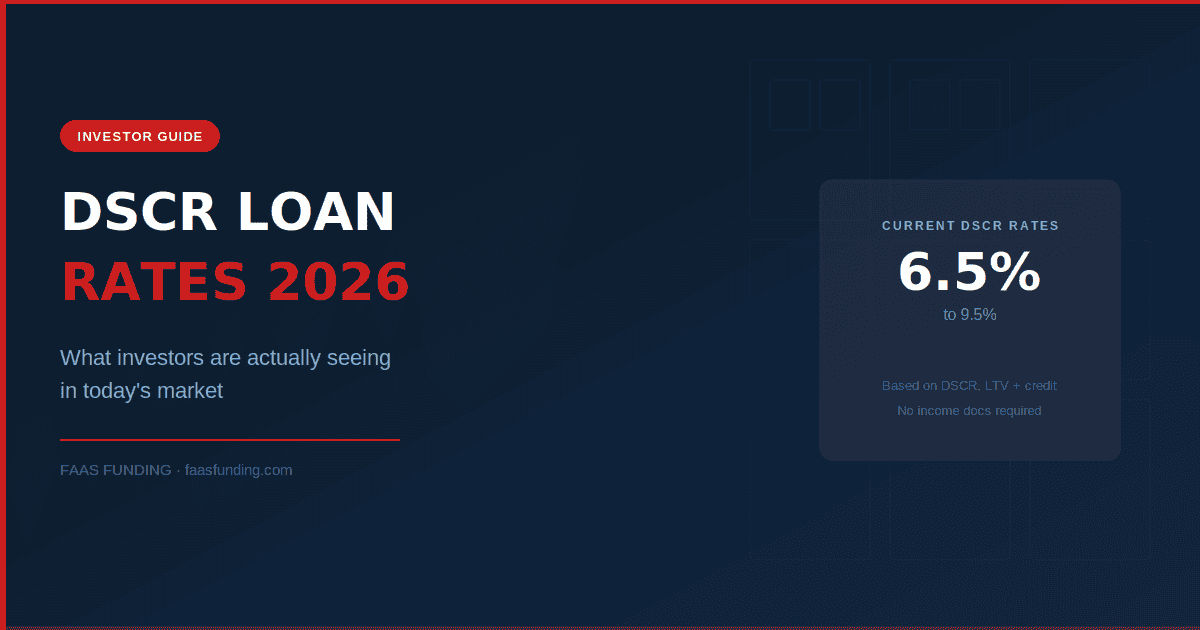
Right now, most investors are getting approved somewhere between 6.5% and 9.5%. The best-qualified borrowers — strong credit, solid DSCR, moderate LTV — are landing in the 6.5%–7.5% range. The investors who show up with borderline ratios and high leverage are paying 8.5%–9.5%. And the ones financing short-term rentals or non-warrantable property types are adding another 50–100 basis points on top of wherever they’d otherwise fall.
What Drives Your DSCR Rate
There are four primary levers lenders use to price a DSCR loan. Understanding each one changes how you approach a deal.
1. Your DSCR Ratio
This is the most important number on your application. A DSCR of 1.0x means your rental income exactly covers the debt service — you’re breakeven. At 1.0x, lenders will often approve you, but they’ll price the risk into the rate. At 1.25x, you’re in the sweet spot: most lenders consider this strong qualification and price accordingly. At 1.4x or higher, you may have access to the lowest available rates and the most flexible terms. In practical terms, the difference between a 1.0x DSCR and a 1.25x DSCR on the same property can translate to 0.5%–0.75% off your rate.
2. Loan-to-Value (LTV)
LTV is the second biggest rate driver. At 65% LTV, lenders have substantial equity cushion and reward you with pricing in the lower tier. At 75% LTV — the most common purchase scenario — rates step up modestly. At 80% LTV, you’re at the upper end of what most DSCR lenders allow, and the rate reflects that additional risk. The spread from 65% to 80% LTV is typically 0.25%–0.75% depending on the lender.
3. Credit Score
DSCR lenders generally work with credit scores as low as 620, but the pricing at 620 is materially worse than at 680 or 740+. A 620-score borrower on the same deal as a 740+ borrower might pay 1.0%–1.5% more on the rate. If you’re sitting at 640 and your score is improvable, it’s often worth pausing for 60–90 days to fix it before applying. A half-point rate reduction on a $400K loan is nearly $100/month in cash flow — forever.
4. Property Type
Single-family rentals (SFR) get the cleanest pricing. 2–4 unit multifamily is slightly higher risk to lenders but still well within DSCR programs. Short-term rentals (STR/Airbnb/VRBO) add a 0.5%–1.0% premium across the board because income is harder to document and markets can shift. If you’re financing an STR, expect to price it accordingly.
Current Rate Ranges by Scenario
Here is a realistic snapshot of what investors in our network are seeing in 2026:
| Scenario | Typical Rate |
|---|---|
| 740+ credit, 1.25x+ DSCR, 70% LTV | 6.5%–7.5% |
| 700 credit, 1.1x DSCR, 75% LTV | 7.5%–8.5% |
| 660 credit, 1.0x DSCR, 80% LTV | 8.5%–9.5% |
| STR/Airbnb property, any credit | Add 0.5%–1.0% |
Interest-Only vs. 30-Year Fixed — Which Wins?
This debate matters more than most investors realize. Let me run the real math on a $400,000 loan at 7.5%.
On a 30-year fixed amortizing loan, your monthly payment is approximately $2,797. On an interest-only loan at the same rate, your monthly payment drops to $2,500 — a savings of $297 per month. That $297 is not magic; you’re simply deferring principal paydown. But for an investor focused on cash flow and scaling, that $297/month matters. It improves your DSCR on the property, frees up cash for reserves or another acquisition, and keeps your monthly nut lower during the hold period.
Interest-only makes the most sense if you’re planning to refinance or sell within 5–7 years, if you’re buying in an appreciating market where equity is building through price appreciation rather than paydown, or if you’re actively scaling a portfolio and cash flow reinvestment is the priority. It makes less sense if you want to pay down debt over time and own properties free-and-clear by retirement.
How to Get the Best Rate
Five things I’d tell every investor before they submit a DSCR application:
1. Improve your DSCR before applying. If your DSCR is sitting at 1.05x, see if you can get it to 1.25x by negotiating the purchase price down, increasing rents, or putting more money down to reduce the debt service. The rate improvement from 1.0x to 1.25x is often more valuable than any rate buydown.
2. Pull your credit early. Know your score before a lender pulls it. If you’re at 672, three months of targeted paydown might get you past 680. If you’re at 718, same principle applies to hit 740+. These thresholds are real pricing breakpoints.
3. Think carefully about buying down the rate. On a DSCR loan you plan to hold for 7+ years, buying down 0.5% with 1 point of origination often pays off. On a 3-year hold, probably not. Run the break-even math specific to your hold period.
4. Understand your LLC structuring options. DSCR loans close in entity names. Some lenders charge a slight rate premium for LLC loans; others don’t. Ask up front. The asset protection of the LLC is almost always worth any small rate difference, but you should know the cost going in.
5. Evaluate prepayment vs. no-prepay carefully. A 3-year step-down prepay penalty (3/2/1) will give you a lower rate than a no-prepay structure. If you’re confident you’re holding for 3+ years, take the lower rate. If there’s any chance you’re selling or refinancing in the next 18 months, the no-prepay option — even at a slightly higher rate — may be the better economic choice.
The rate environment in 2026 rewards prepared borrowers. The investors who show up with a clean credit profile, a property with strong DSCR, and a clear hold strategy are consistently landing in the 6.5%–7.5% range. Everyone else is paying more. The gap between those two outcomes is almost entirely within your control before you apply.
Ready to move on your deal?
Get a free scenario review from FAAS Funding
No income docs. No W-2. Pre-qualification in 2 minutes.